Cobb adopts a path for backyard homes—with permits and limits still central
The county’s final October 27 amendments establish accessory-dwelling standards. For owners considering more flexible housing on an existing lot, the important distinction is between adopting a rule and approving a particular property.
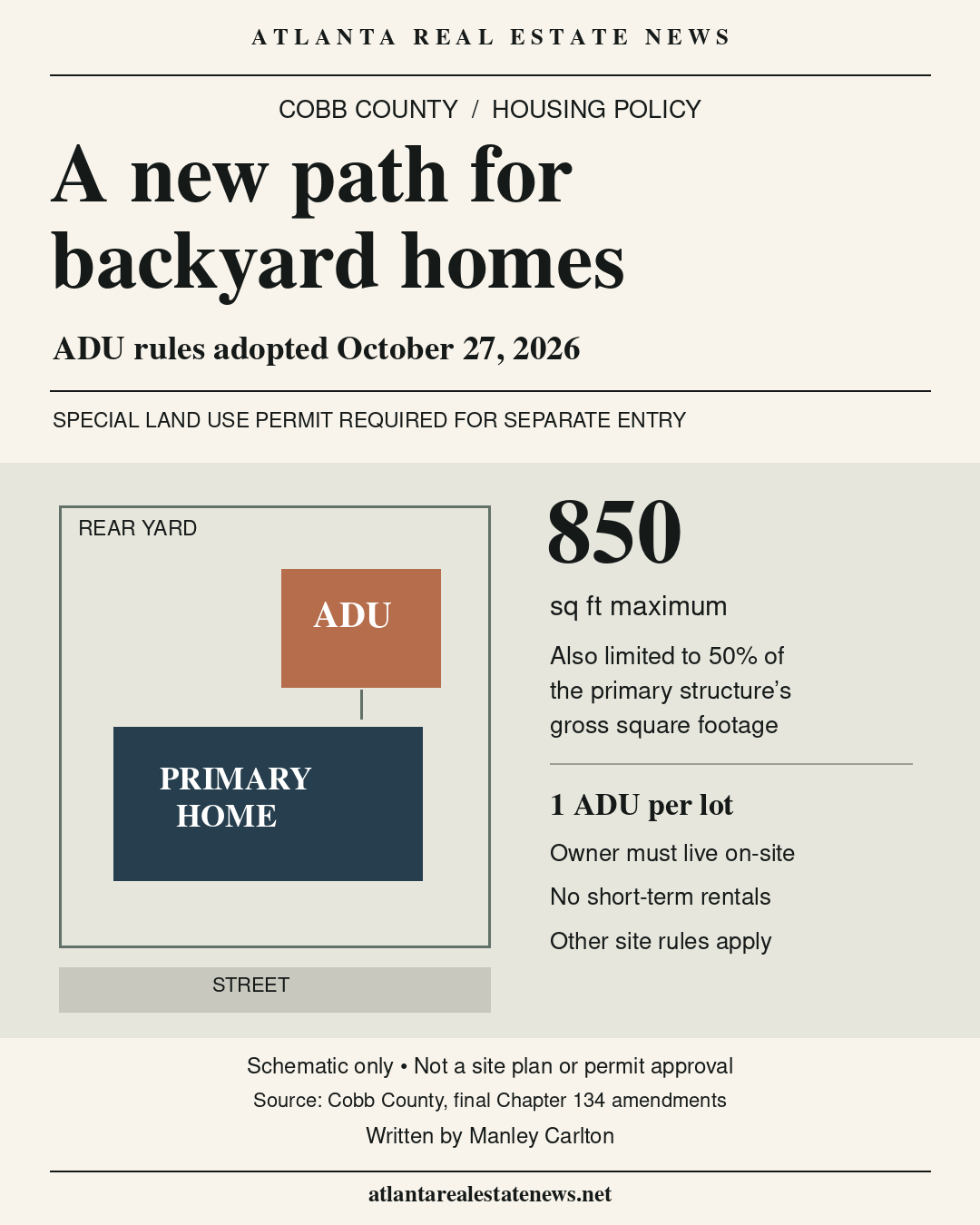
Photo creditDetails
What changed
Cobb County’s published final Chapter 134 amendments identify October 27, 2026 as the adoption date. East Cobb News reported the ADU measure’s 3–2 vote on October 30. The county has now posted both the adopted text and a final revision summary, allowing the approved provisions to be distinguished from earlier proposal pages.
The housing debate
East Cobb News describes the measure as an affordability initiative that returned after a 2024 attempt was withdrawn. Opponents raised concerns about neighborhood character and infrastructure capacity. Those are competing policy arguments; the adoption itself does not establish how many homes will be built or how much rents will change.
The basic scale
The approved text limits an ADU to 850 square feet and 50 percent of the primary structure’s gross area. It allows one per single-family lot, placed in the rear yard. An ADU with a separate entrance requires a special land use permit. This is a report on county zoning; separate municipal rules should not be assumed to match.
How it must operate
The owner must live in the main home or the ADU. Neither may be used for short-term rental. Shared utility meters, at least one off-street parking space, applicable setbacks and impervious-coverage limits are required. The ADU can occupy only one floor of the accessory structure and cannot exceed the main home’s height.
Private restrictions still matter
The final text requires consistency with applicable covenants, conditions, deed restrictions and bylaws, supported by an applicant affidavit. Lot-wide occupancy and parking remain subject to the county’s single-family standards. An available corner of a backyard is therefore only one part of the feasibility question.
Why owners are paying attention
The county’s October 8 explanation described ADUs as a possible housing option for family members, caregivers or other household members. That document predates adoption and is useful for the policy’s rationale, while the final October text governs the provisions summarized here.
Our analysis
An additional dwelling could offer a different way to accommodate a household over time, but its usefulness depends on the actual site. Privacy between entrances, a safe walking route, parking access and the relationship to existing outdoor space will influence whether a design works well. These practical questions deserve attention alongside the headline floor-area limit.
What remains property-specific
This review verifies adoption, not an individual permit, application acceptance date, construction cost or delivery schedule. Before presenting a property as ADU-ready, establish its jurisdiction, applicable district rules, restrictions and approval status. The next meaningful evidence of implementation will be documented applications, decisions and completed homes—not assumed rental income or a property-value premium.
Sources & further reading
- Cobb County — final adopted code amendments; reviewed November 1, 2026
- Cobb County — Chapter 134 final text, adopted October 27, 2026; section 134-37(35)
- Cobb County — final revision summary, October 27, 2026
- East Cobb News — ADU vote and community response, October 30, 2026
- Cobb County — proposal background, October 8, 2026; not the final ordinance
Sources checked 2026-11-01.
About Atlanta Real Estate News
Atlanta Real Estate News is an independent publication covering property, development, business, design and life in Metro Atlanta. We exist to help readers understand what is changing, why it matters and what to watch next through clear reporting, verified sources and local perspective.